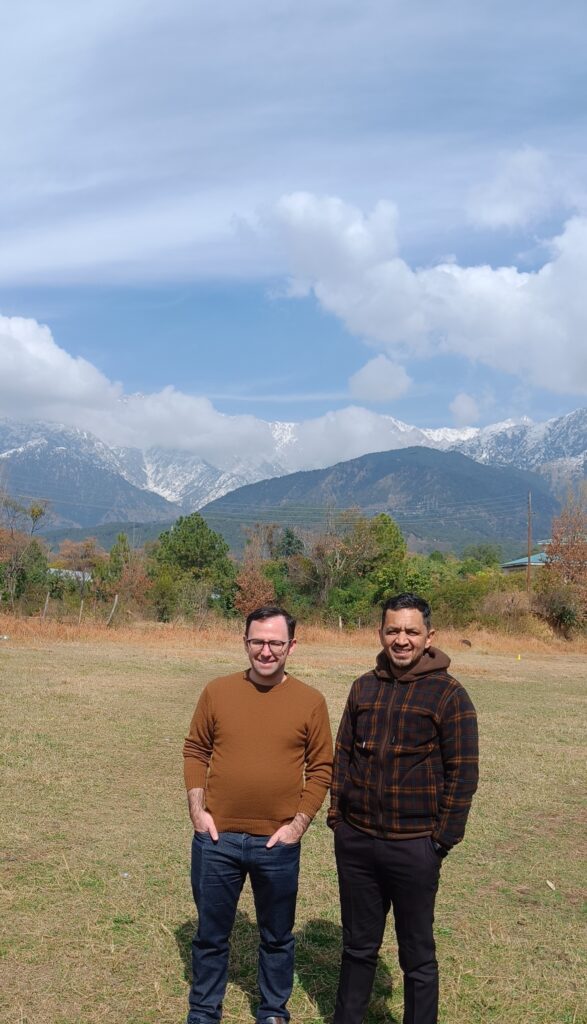
Dr. Trent Brown, an Associate Professor at Tokyo College, recent visit to CSKHPKV Palampur offered deep insights into global teaching, research, and academic cultures. As part of his collaborative research project, “Trainers as Mediators within Agricultural Skill Ecosystems: Perspectives from North India,” he engaged with around 20 extension scientists at CSKHPKV Palampur, exploring India’s agricultural education landscape.
With an academic journey spanning Australia, Japan, and India, his expertise in interdisciplinary research, sustainability, and skill development provided a unique comparative perspective on global education systems.
As local coordinators for his research, my colleague Dr. Manoj and I had the privilege of engaging in regular discussions with Dr. Brown on various aspects of academia, society, and politics in India, Japan, and Australia. Through these insightful conversations, he shared reflections on the distinct academic environments of these countries, offering a comparative perspective that deepened our understanding of research, innovation, and global education systems.
Dr. Brown’s academic journey is impressive—having earned his PhD from the University of Wollongong, Australia, he later worked at the University of Melbourne before joining the University of Tokyo. His experiences provide valuable insights into teaching methodologies, research approaches, and academic culture in these countries.
Here are some of the most compelling insights from our discussions over the past two weeks:
1.Interdisciplinary Research Approach
Dr. Trent Brown, is a dedicated researcher in interdisciplinary studies. His work spans multiple domains, including:
Contemporary India
Food Systems and Agrarian Change
Skill Development and Craft Production
Sustainability and Rural Development
At Tokyo College, he focuses on integrating knowledge from social sciences, sustainability, and rural studies to create holistic, impactful research. His publication style reflects this interdisciplinary nature, aiming for wider accessibility and relevance across multiple disciplines.
2.Field-Based Research Across Countries
Dr. Brown’s research is not confined to academic theories—it is deeply rooted in fieldwork. His studies require him to travel extensively, engaging with farmers, extension professionals, and rural communities in countries like:
India – Studying agricultural extension systems and skill development programs.
The Philippines – Exploring community-led rural extension models.
Japan – Analyzing technology-driven sustainability practices in agriculture.
His commitment to on-the-ground research ensures that his work remains practical, applicable, and relevant to real-world problems.
3.Academic Experiences: Japan vs. Australia
A. Student Behavior and Learning Culture
- In Japan, students tend to be more formal and respectful of authority, reflecting the broader cultural emphasis on discipline and organised structure
- In Australia, the academic environment is less formal and less hierarchical, encouraging open dialogue and independent thought.
B. Faculty Job Security and Work Ethic
- Faculty positions in Japan are often more permanent compared to Australia. However, this security does not lead to complacency—senior faculty members continue to work hard.
- In Australia, job security can be more precarious, with instances of mass layoffs in recent years due to financial constraints.
C. University Funding and Research Grants
- Australia: Universities rely heavily on student fees, including significant contributions from international students. Research grants are fewer but come in larger amounts, often with a strong focus on how the research benefits Australia’s economy.
- Japan: Universities receive more grants but of smaller amounts. The funding criteria are broader compared to Australia, where economic impact is a major determinant.
D. Work-Life Balance and Society
- Japan: A formal, disciplined, and organised society, where long working hours are common, and questioning established norms is less frequent.
- Australia: Higher work-life balance, with weekends typically reserved for personal time, reflecting a more relaxed cultural approach.
Final Thoughts
Dr. Brown’s journey highlights the power of interdisciplinary research, global academic collaboration, and immersive fieldwork. His work serves as an inspiration for researchers and students, demonstrating that true knowledge emerges from real-world engagement, not just academic theories.
On a personal level, I found his high-quality publications in reputed journals and books particularly inspiring. His ability to travel internationally for field research is equally motivating, showcasing how academic work can transcend borders and create a real-world impact.
Which academic system do you resonate with more—Japan’s structured and disciplined approach or Australia’s flexible and open system?
Do you believe field-based research is more impactful than theoretical research?
💬 Share your thoughts in the comments below!