Why Do We Sometimes Achieve More Under Pressure?
Have you ever noticed that on a day packed with work, you somehow manage to accomplish more? Yet, when you have an entire free day, it often passes without much productivity.
Why does this happen?
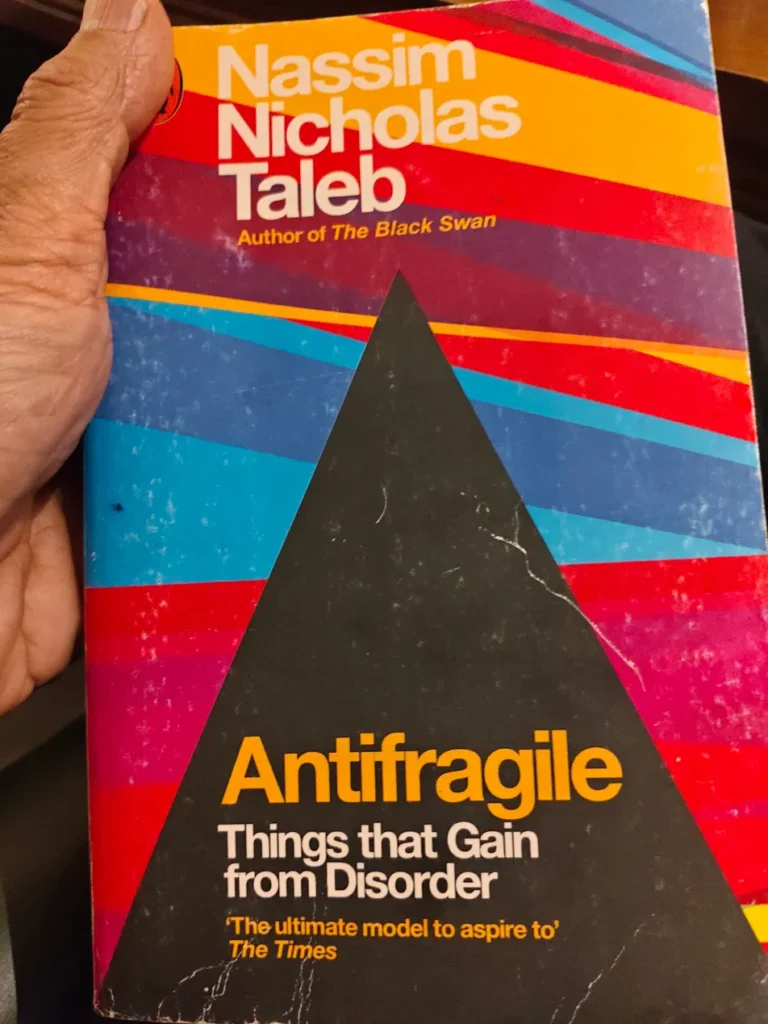
In his influential book Antifragile: Things That Gain from Disorder, Nassim Nicholas Taleb explores an intriguing idea: certain systems do not merely withstand stress; they actually become stronger because of it.
One of the mechanisms he discusses is overcompensation. When exposed to a manageable challenge, a system may respond by developing greater capacity than was initially required.
Think about physical exercise. When we lift weights, our muscles experience stress. During recovery, the body adapts and becomes better prepared for a similar challenge in the future.
Taleb extends this idea beyond biology to education, business, economics, nature and everyday life.
Here are five important lessons worth reflecting upon.
Lesson 1: Too Much Comfort Can Make Us Vulnerable
Modern technology makes many activities easier, but convenience can sometimes reduce our preparedness.
Consider pilots who rely heavily on autopilot systems. Although automation improves efficiency, excessive dependence on it may reduce opportunities to practise manual flying skills and maintain situational awareness.
Similarly, a racehorse accustomed to weak competition may not develop the same competitive edge as one regularly challenged by stronger opponents.
The lesson: Comfort is useful, but permanent comfort can weaken our ability to respond to unexpected challenges.
Occasionally, choose a task that stretches your abilities. Take on a difficult assignment, learn a new skill or compete with someone better than you.
Growth often begins where convenience ends.
Lesson 2: A Little Effort Can Lead to Deeper Thinking
Taleb discusses how the way information is delivered can influence how people receive and process it.
For instance, speaking softly during a lecture may encourage listeners to concentrate more carefully rather than passively receiving information.
Similarly, a moderate level of background activity can sometimes help people focus, although this varies between individuals and tasks.
The broader principle is that learning does not always improve when everything is made effortless.
Students who actively question, analyse and solve problems often develop deeper understanding than those who simply receive ready-made answers.
The lesson: Do not remove every intellectual challenge from the learning process.
As teachers, we should encourage students to think, question, discuss and discover rather than spoon-feed every answer.
However, the challenge must be appropriate. Too little stimulation creates boredom, while excessive distraction interferes with learning.
Lesson 3: What Looks Like Waste May Actually Be Protection
Nature offers an interesting example of redundancy.
Humans have two kidneys, although one healthy kidney can often sustain life. This additional capacity provides a biological reserve.
The same principle applies to business and everyday financial management.
Consider these examples:
- A farmer storing additional fodder for the winter.
- A business maintaining emergency inventory.
- A household keeping emergency savings.
- A university maintaining backup systems and essential resources.
Under normal circumstances, these reserves may appear unnecessary or inefficient.
But when an unexpected crisis occurs, they become extremely valuable.
Taleb challenges the obsession with eliminating every form of redundancy in the name of efficiency.
The lesson: Efficiency should not come at the cost of resilience.
A system operating at 100% capacity without any reserve may perform well during normal conditions but become extremely vulnerable when something goes wrong.
Sometimes, having a little extra is not waste. It is preparedness.
Lesson 4: Do Not Assume the Next Crisis Will Be Similar to the Last
Taleb discusses the Lucretius problem: the tendency to assume that the largest event we have experienced represents the maximum possible event.
Imagine someone who has only seen mountains of 3,000 metres. They might assume that such mountains represent the natural limit.
But the world contains much taller mountains.
The same mistake can occur in disaster management, finance, infrastructure planning and agriculture.
The Fukushima nuclear disaster in Japan demonstrated the dangers of underestimating extreme events and relying on assumptions about the limits of natural hazards.
In biology, however, the body illustrates a different response. Progressive physical training exposes muscles to manageable stress, followed by recovery and adaptation.
The lesson: Do not build systems based only on yesterday’s challenges.
Whether managing a farm, running a business or planning public infrastructure, consider events that exceed previous experience.
Prepare for uncertainty rather than assuming that the future will repeat the past.
Lesson 5: Criticism Can Sometimes Increase Visibility
Have you ever noticed how something becomes more attractive when someone tells you not to look at it?
People often become curious about banned books, restricted information or controversial ideas.
Taleb explores this phenomenon through the idea that attempts to suppress certain information can sometimes increase its visibility.
For authors, thinkers and public figures, criticism may generate attention and curiosity. In contrast, complete indifference can be more damaging because nobody engages with the work.
However, criticism is not automatically beneficial. It can also damage credibility, reputation and relationships.
The important distinction is between constructive criticism, which can improve our work, and unnecessary negativity, which need not control our decisions.
The lesson: Do not allow every criticism to determine your direction.
Listen carefully, learn from valid feedback and continue improving your work.
An Important Caution: Stress Alone Does Not Create Strength
There is a common misunderstanding that antifragility means seeking as much stress or difficulty as possible.
That is not the idea.
The benefits of stress depend on its intensity, duration, frequency and the capacity of the system to recover.
For example:
- Exercise followed by adequate recovery can improve physical fitness.
- Excessive exercise without recovery can cause injury.
- Manageable academic challenges can improve learning.
- Chronic pressure can lead to exhaustion and poor performance.
The principle is not endless stress but manageable stress, adaptation and recovery.
What Can We Learn from Antifragile in Everyday Life?
Taleb’s ideas become particularly interesting when applied to different areas of life.
| Area | Practical application |
|---|---|
| Personal fitness | Gradually increase physical challenges and allow recovery. |
| Education | Encourage problem-solving rather than passive learning. |
| Agriculture | Maintain fodder reserves and diversify farm resources. |
| Business | Build financial reserves and avoid excessive dependence on one source. |
| Career | Develop multiple skills and remain open to new challenges. |
| Risk management | Prepare for events beyond previous experience. |
Final Thoughts: Don’t Just Become Resilient. Become Antifragile.
Resilience means being able to withstand difficulties without breaking.
Antifragility goes a step further: it describes systems that can benefit from volatility, stress and disorder under suitable conditions.
We cannot eliminate uncertainty from life. Nor should we try to remove every challenge from our personal and professional environments.
Instead, we should develop the capacity to learn, adapt and improve when circumstances become difficult.
The next time you face a manageable challenge, ask yourself:
Am I merely trying to survive this difficulty, or can I use it to become better prepared for the future?
That is perhaps the most valuable lesson from Taleb’s Antifragile.
Your Turn
Have you experienced a situation in which a difficult period ultimately made you stronger, more skilled or better prepared?
Share your experience in the comments. Your example might help someone else look at adversity differently.
References and Further Reading
Taleb, N. N. (2012). Antifragile: Things That Gain from Disorder. Random House.